 A silver lining about getting laid off is that
you get another 8-10 hours to slow down and ponder about life without the
distractions of work.
A silver lining about getting laid off is that
you get another 8-10 hours to slow down and ponder about life without the
distractions of work.
Lately, I’ve been really thinking about the world we now live in, specifically all the things we have grown accustomed to that I would’ve been very surprised to know just 5 years earlier. 5 years is a somewhat arbitrary number, but I’m using it to try to bound a smaller time horizon and not include just every change from the time I was born.
So I will now compile a list of recent surprises.
I. Attention Span Collapse
While Tiktok and other predecessors like Vine existed 5 years ago, it was the COVID-19 Lockdown that served as the catalyst for the explosion of the short-form video (SFV) format. During lockdown, I think most people (myself included) were more concerned about finding a way to entertain themselves rather than the effect that SFVs were going to have on their attention span and general ability to think.
The negative impacts on cognitive perfomance are increasingly backed by scientific studies. This recent meta-analysis “reveals a consistent pattern linking higher SFV use with poorer cognitive performance, particularly in attentional control and inhibitory processes”. Another interesting paper has to do with the effects of consuming brain rot content on LLM performance. The results were likewise not pretty.
I'd like to think that I was somewhat cognizant of this problem by setting a 1 hour limit on Tiktok, Instagram, etc and actually doing a good job at adhering to those limits. However when I think of it now, 1 hour a day is still a lot of time. Especially when I was still consistently maxing it out. 1 hr/day is 15 days a year. When you add it all up, that's 15 days a year on Tiktok, 15 days a year on Instagram, 15 days a year on Reddit, etc.

That's a lot of time to spend on content that isn't even particularly memorable. As a thought experiment, can you remember the last Tikok, Reel, etc you watched?
It's time that you could've spent thinking about your own problems. Our brain uses Tiktoks and Reels to fill the gaps in our day in an attempt to ward off bordeom. However, boredom is actually good for us as it forces us to do some introspection. It's a useful discomfort that is better than giving our mindless attention to something else.
As a result, I have just decided to delete my Tiktok, the app I was using the most. I would encourage others to do the same for whatever SFV platform they use. It will be increasingly important to preserve what cognitive abilities we still have.
Now i'm annoyed because having to think about and manage my content consumption hygiene sounds like a Black Mirror episode.
II. White Collar Labor Collapse
While there are many reasons behind the layoff trends in tech, and AI was still not able to replace me individually, the collective efficiency gains from AI usage is beginning to make an impact.
5 years ago, before the widespread adoption of Gen AI, there was a general understanding that technology would rapidly replace manual labor, but very few people would’ve expected that it would go for mental labor first. Intuitively it seemed easier to design a robotic arm to work on a factory line than it was to design some algorithm to mimic human intelligence. Recent events have proved this line of thinking wrong.
So while beforehand I would’ve considered myself simply an unlucky victim of poor market conditions, I am now beginning to think that I am a proverbial patient zero of a new status quo. While it’s still very likely that I’ll find another job, it’s not so likely that stability will ever be guaranteed to me or anyone else in any industry. And at some point in my life, there may actually be no more jobs.
I believe that we are entering a transitional period that is going to be very painful. As compute power expands, LLMs improve, and inference costs drop, GenAI will eat its way up the cognitive totem pole. Jobs that require the least amount of intelligence will go first, till eventually AGI arrives and no job will be safe.
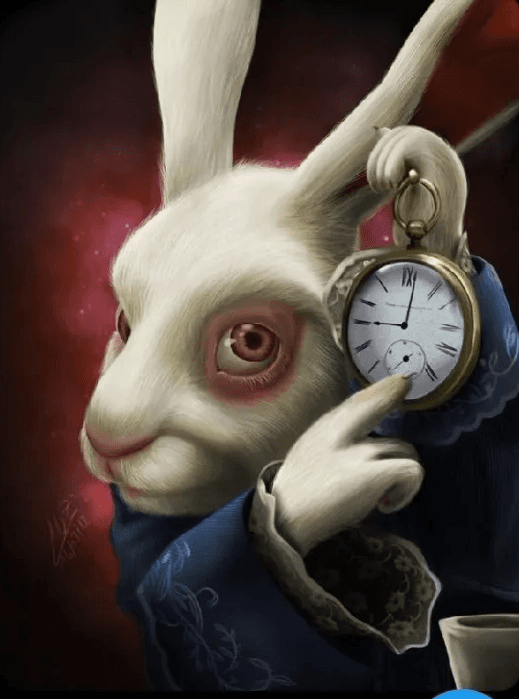
Effectively, all workers are now on a clock.
Some might argue that GenAI may lead to a temporary increase in unemployment, but will create more economic opportunities elsewhere in the future. Similar to how tractors, automated switchboards, CAD, etc have all displaced labor, but still led to increases in productivity in the long run.
However, my perspective is that Artificial General Intelligence, the end goal of all this AI development, is to completely replace and surpass human intelligence. The General part of AGI means that it will be deployed universally, across every job possible. There is no where to run from this.
You can hope that AGI will not be feasible, but history has shown us what is possible when all the brightest minds are collectively working on one project.
This will have profound impacts on Gen-Z behavior as we will start embracing employment instability as just a facet of life and will affect other aspects of society.
One collapse that I think is coming soon will occur in the residential real estate market. House valuations in America are predicated on the fact that Americans are willing to take out 15, 30, etc year mortgages to buy a house. With increasing job instability, very few Americans are going to feel safe enough to take that risk on. In an already cold real estate market, I expect prices to continually drop as existing homeowners realize that there will not be another generation to pay their asking price.
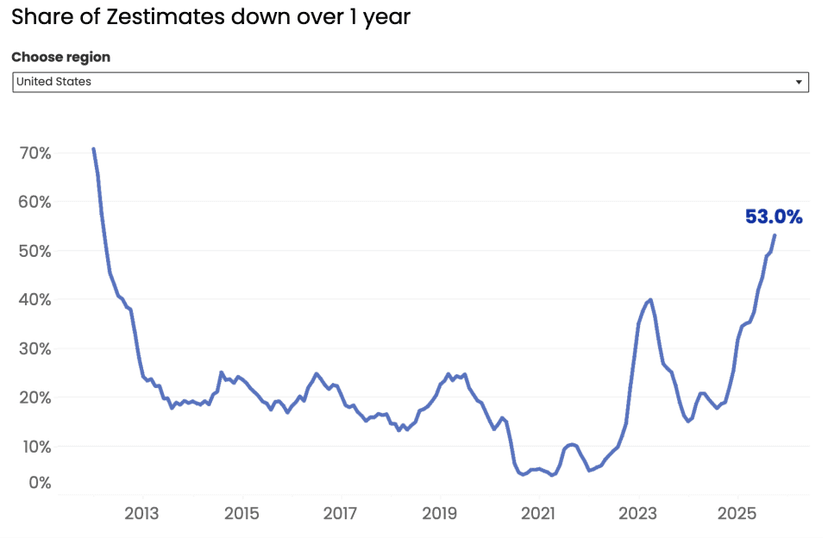 According to
Zillow,
over 50% of houses have seen their values drop in the last year.
According to
Zillow,
over 50% of houses have seen their values drop in the last year.
III. Dating Market Collapse
A possibly biased collapse from the perspective of a hopeless romantic, but one that I do think is universally shared by many. I think dating has never been easy, but surely it was never meant to be this hard?
I’ll still put this one as a surprise because 5 years ago, the general attitude towards dating was different. When we were first hopping on dating apps and finding love online, it seemed genuinely exciting. People were engaging online AND eager to meetup in real life. With the ability to pre-emptively screen attraction from thousands of people in your area using just your phone, it felt like being single would soon become a solved problem forever.
Oh how wrong I was.
At first, human behavior IRL was dictating in-app behavior. People matched often, and planned to meet up quickly. However, then we started becoming greedy.
—Ok, she is attractive, but perhaps I can match with someone that is even more attractive. Or at least, someone that is more attractive than my ex.
—He’s cute, but he doesn’t have a good job. It just doesn’t feel right when I just went on a date with a doctor before. Perhaps, I should hold out and keep swiping.
Soon, we all started indulging in our hypergamous tendencies and now it feels like nothing will satisfy us. Matches happen less, and conversations quickly die out before they lead anywhere. And maybe you do plan a date, and they end up cancelling last minute.
I am beginning to fear that this behavior is also bleeding out into real life. Real life interactions are scarcer. Men are scared or unmotivated to approach in person, and women are jaded by poor past experiences. All of this is leading to a historically single society.
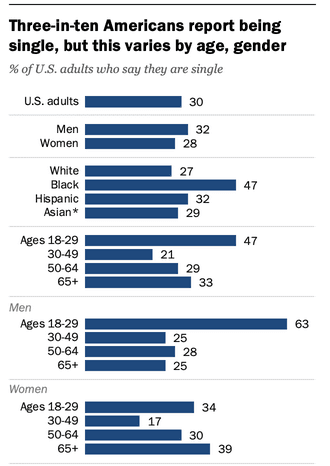
It’s not immediately clear to the writer here what the solution should be.
IV. Working Weight Loss Drugs
V. Self Driving Cars
Conclusion
Now you will ask, “Seriously Kevin? No further diatribes about Ozempic or Waymo?”
In my defense, I had actually begun to fill those sections out. However, the paragraphs would’ve ultimately been summarized as “So this works now, cool”. While the advent of these technologies is surprising and impressive, they are also fairly self explanatory.
While I do believe that the arrival of Ozempic has meant America has passed peak obesity and that Waymos will steal crucial jobs from gig workers, it is still too early for me to reflect on their impact.
As always, if you made it all the way here, thanks.